Get Ready for Food Prices to Move... Even Higher
“The worst is yet to come,” said Scotiabank economist Olivier Gervais


Over the weekend, The Wall Street Journal ran an article discussing why food prices, after rising at the fastest rate in the last six months during October, are poised to move even higher.
Food costs rose at the fastest rate in six months in October, driven by snarled supply chains, unpredictable weather and, increasingly, high fuel prices because of the Iran war. The cost of restaurant meals rose at the fastest pace since December 2025.
And now, more farmers and big food manufacturers are preparing to pass higher energy costs on to consumers.
“The worst is yet to come,” said Scotiabank economist Olivier Gervais.
What’s driving this?
The cost of transportation services has increased by 20% since the start of the year, according to the Labor Department, signaling that trucking and logistics carriers are passing elevated diesel bills down the line to wholesalers and processors.
Fresh fruit is already costlier to import, a spokesperson for fresh fruit and vegetable distributor Dole said, as expensive fuel inflates shipping, fertilizer and packaging costs. Weather conditions caused by a powerful El Niño have only compounded the strain.
Crude oil prices have dropped from recent peaks, but the fuel that powers food distribution has stayed stubbornly expensive. Retail diesel prices have increased by more than 66% since the start of the war in Iran, reaching a record high of $6.53 in September.
We’ve seen gas prices move lower over the last month with the latest from AAA putting the average gallon of gas at $3.82, and Sunday I saw $3.60 for good ol’ 87 gas. That’s below the $4 psychological pain threshold that tends to catch most consumer eyes and wallets when tanking up.
Diesel prices per AAA have fallen to around $6 per gallon, well of their high but still ~ 60% higher compared to $3.77 per gallon this time last year.
We can thank the sharp drop in oil prices for the recent drop in oil and diesel prices.
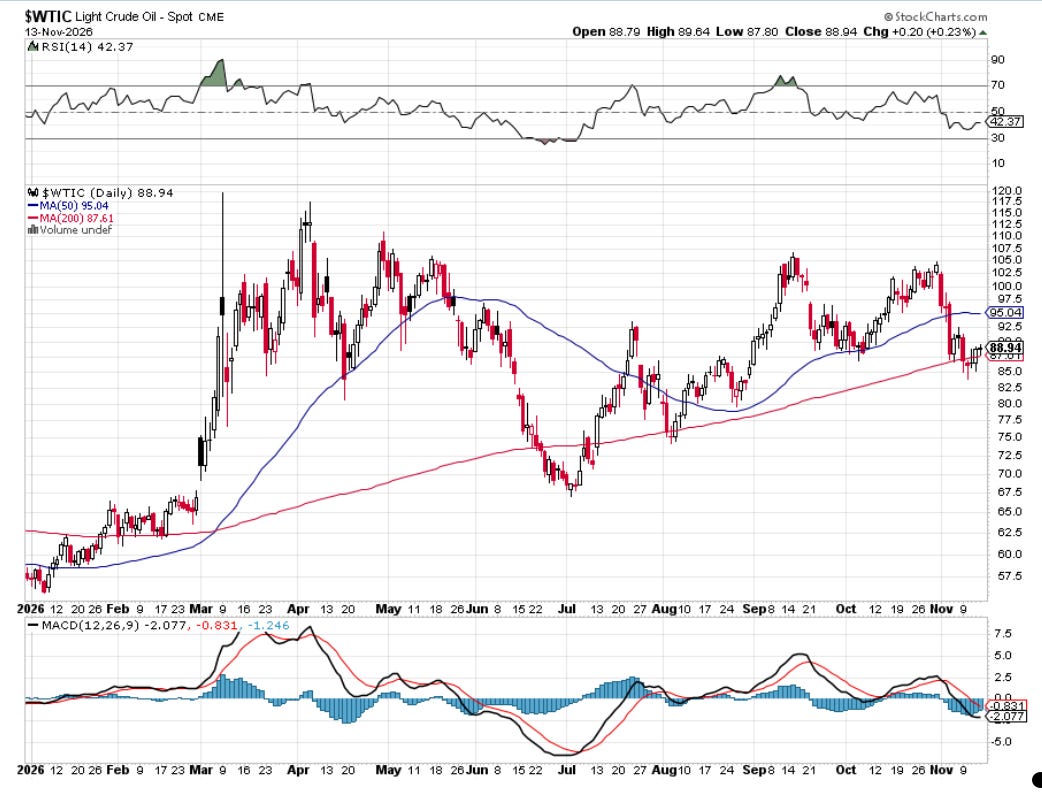
The Guardian recently wrote “The world’s oil supply is swinging back to a surplus for the first time since the start of the US-Israeli war against Iran…” based on data from the International Energy Agency.
Whether we see further improvement in energy prices will hinge on what comes next between the U.S. and Iran. A few days ago, the UN’s nuclear watchdog said it is “increasingly concerned” about a nuclear facility in Iran which it has not been allowed to inspect.
The question is will the Trump administration use that as cover for further attacks on Iran or not?
What makes it hard to call is that it seems even President Trump isn’t sure what he’s inclined to do. Per Reuters on Sunday:
Trump has alternated between threats of escalating the war with new strikes and winding down hostilities, and current and former officials say he does not appear to have made up his mind about how to resolve the unpopular conflict, which he launched in February with Israel.
While much attention will be paid this week to quarterly results from Nvidia (NVDA) and Anthropic pricing its IPO offering, comments from Walmart (WMT), Home Depot (HD), Tyson Foods (TSN), Lowe’s (LOW), Target (TGT), Ross Stores (ROST) and Gap (GPS) about what they see with the consumer and holiday spending has the potential to reshape market expectations.
Discussion about this post